The late 19th and early 20th centuries mark the beginning of a series of studies aimed at combining the scientific rigor of each period with the respect due to the religious nature of the relic.
These early works, in which Canon Eugenio Escobar Prieto stands out, took place in the context of other studies being conducted on the “Shroud of Turin” and the “Holy Tunic” preserved in Trier.
In the late 1950s and early 1960s, the relic became the subject of renewed interest.
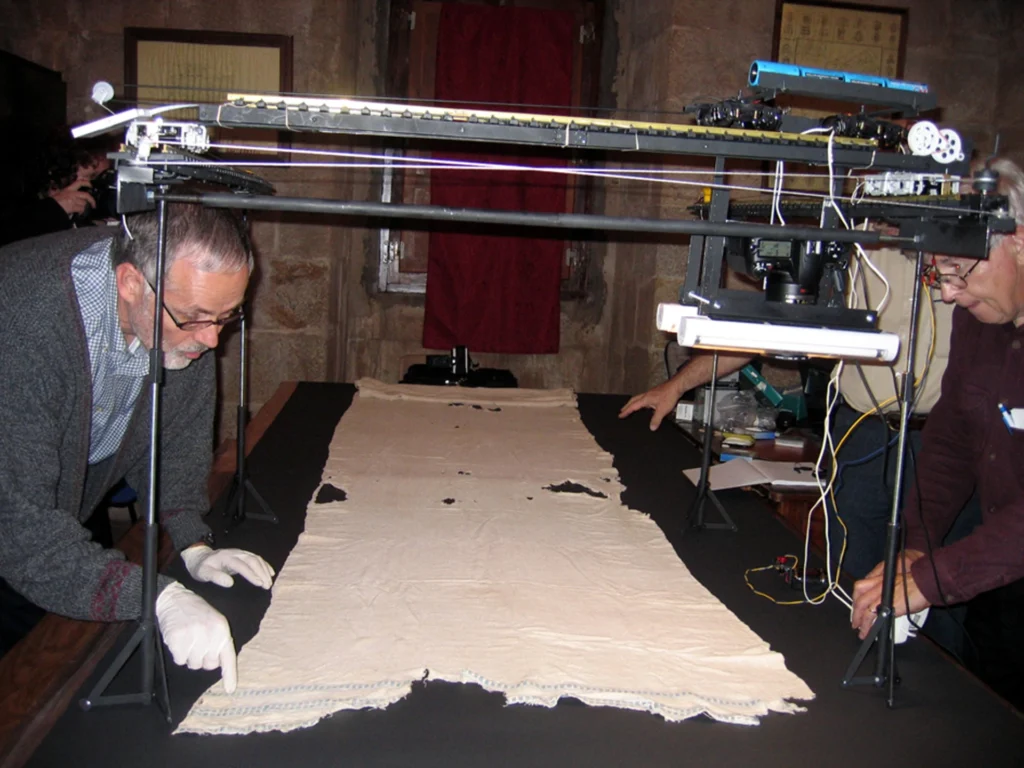
In 1960, it was analyzed in Madrid by Dr. Alfredo Carrato Ibáñez, Dr. Francisco Hernández Pacheco, and Dr. Manuel Gómez Moreno, who determined that it was made of linen in the Middle East. It was later studied by the American John Jackson, who visited Coria in 2006 and 2007. It was also examined by scientists from the Spanish Center for Sindonology in 2006 and in laboratories of the CSIC, which established that the blue dye is natural indigo.
A report by Pilar Benito García, textile conservator at the National Heritage, dates from 2011. The most recent study, microstructural and geochemical (2019–2020), was carried out at the University of Oviedo.
Further research is still pending, especially palynological and historical studies, which may scientifically determine the origin and age of this piece.